Tuesday, September 30, 2014

Reading Response Chpt. 13

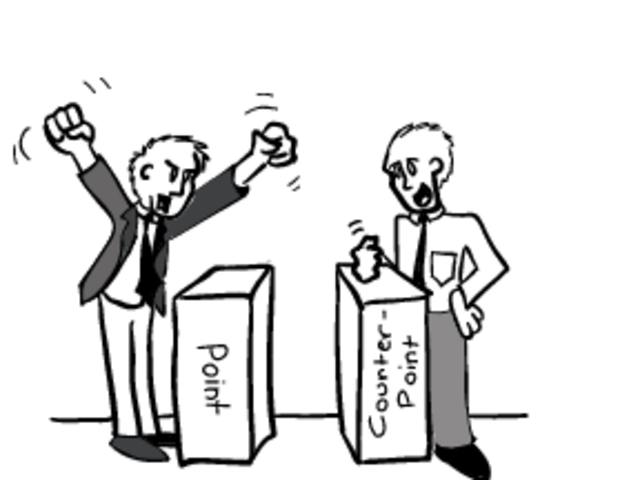
I found this chapter to be very interesting and very informative. I like how it distinguishes the difference between argumentation writing and persuasion writing. Also I enjoyed the chapter talking about the use of purpose, and supporting with logos, pathos, and ethos. I think what a reader should take away when reading this chapter is to know what they are trying to argue, use the proper supporting methods, and use inductive and deductive reasoning. also the reader should know the points and the counter points to their argument.
image
<SW>

Friday, September 26, 2014

Blog Review

I decided to review the blog frccwritersblog.blogspot.com. When I first looked at the blog my initial reaction to the look was that it was a general layout and nothing special. Even then the blog was easy to navigate.

Now I will go over the criteria:

  • Continuity of focus: The authors did a great job staying on topic. 
  • Content Clarity: Most posts are very clear, however there are a few that would be confusing to someone who is not in the class (ex - In class thingie of lifeosuction.) 
  • Organization / Design: Like I said earlier, the layout is nothing to write home about but it is easy to navigate. 
  •   Amount of relevant information: Each post has just enough quality text to get the point across without tiring the reader or loosing the readers interest. 
Some minor problems I noticed while reading were some small spelling errors and some posts were missing the required visual component. If the authors of the frccwritersblog could fix that then I think that they have a good blog on their hands! keep it coming Rebecca, Cole, Jonathan and Claire! 
~ AE

Tuesday, September 23, 2014

Drunk Writer Talk Blog Review

Review a blog from T, Tr Eng 121
Drunk Writer Talk

This blog drew my attention from their title: "Drunk Writer Talk", which could go one of two ways: a sloppy slur of thoughts or a humorous group of folks with something to say. In my opinion, it was the latter (thankfully).
Image

First impressions: The layout is unique, and obviously took some sort of blogging skill. It is apparent the editors of the blog took time to personalize their webpage and care what people think. There is a small survey on the right side of the page for visitors to rate the page, I thought that was a nifty tool- I wonder where they got it? I suppose I could Google it. Speaking of Google, this blog also has an interesting Google News Bar at the top of their page. I'm not sure the relevance it has to their website, but I found that I liked it anyway.

Quality Criteria Ratings (Scale 1-5, 1 being poor, 5 being outstanding):

  • Continuity of Focus? 5- well, since this blog was created for one purpose, the participation and involvement in English 121, the focus is to post responses, reflections, and assignments as according to Jenn, which the group follows. There aren't any random posts of spilled-wine-at-midnight-thoughts to deter from the point, so all points earned here. 
  • Content clarity? 3- While each post does have a title and a point, it is a little unclear what the post is overall regarding. I think with a more clear title and structure of post this number could easily be bumped up.
  • Organization: 4- The blog has structure, an archive, contributors, a title, etc. All parts are in place, but there are a few outlying images and sub-titles that I am not sure have a point. For example, what is the "Saving Lives One Grandma at a Time" and following icons about? I can't figure out if it is simply an expression of character or part of the theme.
  • Design: 2- I have a tough time grading this low, especially since it seems they spent time customizing their blog, but it is not reader-friendly. The italicized white text which is in far too thin of margins is difficult to read. The background, while interesting is distracting from the text. As I said before, the random texts and icons have me confused. My suggestion would to widen the text content margins and make the text box opaque, not translucent. That being said, I do like the calligraphy title and tea time picture. I am a little confused how "Drunk Writer Talk" translates into a Victorian tea blog design, though. I might be missing the point.,, I do that sometimes.
  • Amount of Relevant Info: 3- There seem to be a lot fewer posts than I would expect. I only found one chapter five review and two chapter seven reviews. For having three editors, I would expect three of each. There were not any chapter three reviews, but perhaps their blog wasn't up and running yet. 
Overall I think the editors of drunkwritertalk121.blogspot.com have creativity and inspiration, but the blog could use some tidying up. They do their in class assignments, but lack on homework (from the blog perspective, they could very well be turning in hard-copies of the homework). 

-AA

Blogger Review

I chose the http://ridingaturtle.BlogSpot.com. I chose this blog mainly because I felt the name was really catchy. Using our QC that our class came up with I found that the continuity of focus is used very well with this blog group. The content clarity and the organization of the students that use this blog was also done well. Everything is done to what I feel is the class  standards.
I found the design of their blog really cool, and I really like that their name matches their background which is a turtle. The colors I feel draw you into their blog, also the choose of pictures for there blog posts are really catchy and go with what they are writing about.
The information used is relevant to all the chapters and to the in class work that was done. Over all I feel that they are doing a well job at blogging and completing their work.
<SW>

Wednesday, September 17, 2014

In class thingie:

1) Freaking Point: Everyone agrees that this kind of cosmetic makeover is wrong . But what about lifeosuction - the removal from one's biography of innocuous yet somehow unsightly elements that happen to be true?

2) # of examples:

  1. Thomas M. Menino campaign
  2. Joseph Ellis - Pulitzer prize
  3. The Myan pesant woman
  4. Paul Parks - Civil rights
  5. Sandra Bullock - High School
  6. Jim Morrison - Soon of an admiral
  7. Vanilla Ice
  8. Bill O' Rilley
  9. Mike Barnicle
  10. William Henrey Harrison vs. Martin Van Buren
  11. Harold Wilson
  12. Mmichael Meacher
  13. Subcomandante Marcos
  14. The sermon on the Mount
  15. Edmund Burke
  16. Book Publishers
  17. Personal ads - web pages
Reading closely and thinking critically:
  1. According to Murphy people engage in lifeosuction to defend against attack against their social class or social status. 
  2. Murphy saying "It's easy to raise an eyebrow at lifosuction, but hard to be censorious" is interpreted by Addie and Amanda that though it may be obvious that someone is withholding information or "sucking" it from their written biography, it is not entirely false or lies, making it tough to hold reason for being critical. It seems to Murphy, that lifosuction is a serious issue because he has over 15 examples of famous figures who have been prone to the lifosuction scheme. 
  3. The elements which are removed in many of Murphy's examples are called "innocuous", but in reality, they are not necessarily harmless. For example, musician Jim Morrison of The Doors, simply removed the fact that he was the son of the admiral. (Ch7, pg 251 Patterns for a Purpose) This hidden information did not hurt anyone, nor Jim himself when it was revealed. An example of an element considered harmful could be a politician cheating on his wife, this revelation would not only hurt their marriage, but the trust of the country as well. 
  4. Many of Murphy's examples may result in the removal of privilege to reduce or raise that person in his or her social status. The idea of lifosuction is to protect and defend against rumors and slander at ones status or class, so hiding privilege could be a defense mechanism. 
  5. "You're just trying to dig up dirt on me" said by Joe Menino is surprising because the information found by the reporter was not bad or harmful, just that he had a college degree after all. It is ironic for Menino to react this way because he had nothing to hide in the first place. 
Examining Structure and Strategy
  1. The general population may be offended or critical against hidden facts or lies. However, is it deemed okay to simply withhold the truth, without speaking on it further to benefit oneself? 
  2. Murphy's tone is a serious curiosity in regards to this phenomena, lifosuction, which is consistent throughout his essay.
  3. The examples given in paragraph three are legitimate lies about one's past, not lifosuction. This contrast is important because it shows the difference between lifosuction and falsification of biographical information. 
  4. Murphy introduces the topic sentence in paragraphs 3, 4, 5, 6, 8, and 9. These introductions are helpful to keep the essay and examples organized, allowing the reading to follow what the author is trying to say. 
  5. Murphy organizes his examples by the topic sentence of the paragraph. There may up to five examples within a paragraph, but all relevant to the general idea stated in the first sentence. 
Considering Language and Style
  1. Lifosuction was created by the author of the essay to have a word to explain the mysterious concept he had noticed. How it was created is unknown as the reader, but it could be assumed that he generated the idea from the presently existing term, liposuction- to remove excess fat, and altered it to the removal of excess life. The term is clever in the idea that it helps support his argument, but still kind of cheesy. 
  2. Tribune- upholds and defends the rights of people
    Dint-a force or power to cause a dent
    Cadre-a group of trained individuals
    Pugilist- a person who fights with fists
    Proletariat- the lowest class of people, poor
4) Create your own thesis:
Amanda: Will update at home. 
Addie: Technology can prove to both be very beneficial and also an extreme draw back. 


Chapter 7 reading response:

In chapter 7 we learn about Exemplification essays and how to use good examples. Some things that I had never thought about before this reading are that examples are not only for giving the reader something to think about that goes along with the text but also they are there to help clarify a point. Also I learned about hypothetical examples which are "...examples created by the writer as typical examples based on knowledge, experience, observation, and so on" (pg 238). I think Jenn wants us to understand examples and how to use them in an essay and to understand the exemplification essay structure.                                                               Image

~AE

Tuesday, September 16, 2014

Chapter 7 Reading Response

In chapter 7, it shows how important the use of examples are. I found the techniques that where given in this chapter to be very helpful in writing. the things I found most interesting in this chapter would be the different forms of examples, for instance using different approaches for whether you trying to entertain, narrate, inform, or describe in your writing.
The things I feel a reader should take away for this chapter are use the proper examples for what they are writing to include language whether being humorous or serious. I also feel readers should remember to research their examples if needed for that particular form of writing they are doing. image
-SW-

Monday, September 15, 2014

Chapter 7 Reading Response

This chapter highlighted exemplification-the use of real or hypothetical examples to support your argument or thesis in an essay. The section which I found most useful was "Introducing Examples in a Series" because it clarified how to program an example in a sentence, let alone an essay. I realize now that I have been using my commas, colons, and 'e.g's all wrong. I am grateful to have been shown the correct way and have tagged this page for future reference.

I think that the most critical point in this chapter was avoidance of plagiarism when using examples. I can see how easy it might be to suggest an example without citing it correctly, but had no idea that if you omit a word from a quotation you should provide an ellipse. I doubt that most people intend to plagiarize, just like most people don't intend to get a traffic ticket, but it's useful to know the actual rule or law to prevent yourself from getting into such situation.

Lastly, I especially enjoyed Shona Shequeria's essay "Food for Thought". I felt that her use of description, examples, and personal opinion created a moving piece which left me considering her topic. I think that the length and paragraph structure had excellent flow with supportive ideas to her thesis. The fact that she is not American-born herself brought a raw perspective to her insight and examples, making them seem perhaps more meaningful.

In summary, examples can be important in supporting an idea. For example, as Shona Shequeria states
"...For instance, ask for a Chinese fortune cookie and you will always get the same
bland thing (often containing the same fortune, too). On the other hand, request an
American cookie, and you can be showered with hundreds of delectable options,
including oatmeal raisin, double chocolate chip, macadamia pecan delight, and 
coconut brownie ("Food for Thought." Patterns for a Purpose. 6th edition. 2011. Print).


image original, edited by Amanda Alexander for content relevance.


Reading a political cartoon

The image that drew our attention to review:

We believe the purpose of this image is to showcase the idea that the rest of the world sees the United States as nothing more than a gun shop. The "stand your ground" suggests that the domestic gun owners in the United States are dangerously prone to using their fire arms in lieu of other diplomatic options. 

The artist uses simple lines and shading to, instead of providing depth, act as a defiance of depth. The country is portrayed as a single story building, with no greater meaning or diversification. The texture of the image is very flat as well, almost lacking, which helps portray the identity of the country as nothing more than a source of weaponry and violence. 

The light is angled towards the billboard which casts a shadow behind it, over the rest of the country. 
Color is limited to the title "Guns-R-Us" which suggests the billboard as the thesis of the picture. The only other color which exists in the image is the yellow face smiling from what would be the Gulf of Mexico, perhaps welcoming you into the store, but the meaning remains rather ambiguous. 


Overall the elements of the image come together to paint a very strong picture of the artist's opinion s of America. To the artist, the country is nothing more than a gun depot, simple and undiversified in its purpose. Lacking in color, depth, and texture, America is limited to the singular purpose of being a source for firearms. 

-AA,AE,CC,SW

Wednesday, September 10, 2014

Correlation ≠ Causation

The general thrust of the statement: "Correlation does not equal causation" is that just because an event has occurred does not mean that it is the result of a recent and unrelated event. For example, a customer complained to a Centurylink tech support agent that their computer stopped working after their internet was installed. In reality, the internet installation had nothing to do with the function of their computer. This common jump-to-conclusions can be found in many news articles, and the reader should always use caution while perusing these articles so as not to fall for this logical fallacy.

When writing ensure that any chain of events that you are referring to or describing has a clear and logical relationship between each event. It is important to show direct ties and statistics relevant to your point and nothing more. Avoidance of this logical fallacy is simple task and will ensure that your article or research is not dismissed because of faulty information.

image
-AA, AE, CC, SW

Monday, September 8, 2014

Group Blog Review


Using a class criteria review sheet, our group came to the conclusion that the blog IFLScience, written by Elise Andrew rated best:

  • What makes this blog interesting? The popularization of "real" science as opposed to faux science using popular media. It gives sources, hard information linking to articles put into everyday terminology for ease of understanding on social media. 
  • Ratings:
    • Continuity of Focus- 10 
    • Content Clarity - 10
    • Organization -11 (*We find it extremely organized and appreciate the filters for different branches of sciences)
    • Design - 10 (the color coded content sorting won our hearts)
    • Amount of Relevant Information- 10 (overwhelming amounts, consistently updated) 
-AE, AA, SW, CC

Wednesday, September 3, 2014

Chapter 5 reading response

In chapter 5 I learned a lot more about describing my work. Until I read this chapter I had never realized that there is much more to it then what you may think. Here is a quote from our text book that I had never thought of, "Description can entertain, express feelings, relate experience, inform, and persuade" (pg 120). I think Jenn wanted us to realize that description is important because it helps readers form mental pictures and she wanted us to learn how to use it with other patterns to add interest to our writing.
~AE

Tuesday, September 2, 2014

Response to Chapter Five


I am always looking for ways to broaden my vocabulary but a teacher I had once told me “not to use a thesaurus to write my paper for me”. This chapter clarified what he had meant.  I appreciate the color-coded organization chart visualizing a descriptive essay and plan to refer back to this chart. The checklist for revising description also stood out as a tool I can use to improve my writing. Reviewing the things which stuck out to me has let me understand my learning style a bit more: I like lists, I like organization, and I like examples. 


I did not do them before, shamefully, but the writing assignments at the end of the readings are really helpful in applying what I just read. I plan to complete these “quizzes” more often and look forward to reading back and seeing my progress. 

Chapter 5 Reading Response


The things I found most appealing in Chapter 5 would be using the description of all five senses to draw the reader in. I also found the use of metaphors really interesting and maybe I will start to use them more often. I fell that the points someone should take out of this is to make sure they are extremely descriptive in writing to interest their readers, and they should use similes and metaphors to show the different ways to look at things. You should also pay attention to the different description methods for example, organizing details, descriptive words general and specific, and supporting details. If you can find ways to use all of these in your writing you will succeed for sure.
http://image.slidesharecdn.com/introductiontodescriptivewriting-110707130848-phpapp02/95/introduction-to-descriptive-writing-1-728.jpg?cb=1310062234
~SW

Monday, September 1, 2014

"This CD-ROM can hold more information than all the paper that's here below me" - Bill Gates,1994

Consider this image a relevant preview to my Mini Essay #1 regarding technology and education. -AA 
image cred

Update 18:46: Blogger, I invite you to read my short essay on technology and education. View here, comments are welcome.

Chapter 3 reading response


In chapter 3 I learned that essay structure is not as ‘structured’ as it may seem. There are still guidelines for the introduction, body paragraphs and conclusion but there is more wiggle room then you may think. I think Jenn wants us (the students) to further understand how to support our body paragraphs with detail, how to establish tone and make one paragraph flow to another. She also probably wants us to learn the difference between revising our drafts and editing them.

~AE